
INTRODUCTION
How and why fans respond to celebrity activism represents an important, but understudied, area of investigation, particularly in the context of popular musicians (i.e., professional recording/touring artists who enjoy commercial success) who leverage their platforms for social, political, and environmental advocacy. Artists often share their personal views in their lyrics, in interviews, at live music events, and through digital/social media channels. In turn, fans respond in complex, often polarized, ways. Reactions to celebrity activism are shaped by many factors, including fans’ admiration for the artists’ music and persona, the artists’ perceived authenticity, fans’ emotional investment, and alignment with mutual personal values (Jain et al., 2024; Park, 2019). These dynamics become especially pronounced in live concert settings, where the immersive nature and group dynamics of performances can amplify both support and backlash (Mulder & Hitters, 2023; Wulansari et al., 2024).
BACKGROUND
Musicians and songwriters, like actors, appeal to us because they can channel emotions through art that we might find difficult to face otherwise. To do this, they bring their own experiences to their art, and fans often find inspiration and comfort in messages conveyed through song. The inspiration and comfort fans experience cause them, in many cases, to feel attached not just to the songs but to the artists performing them. Fans hunger for more information about the private lives of their favorite celebrities, keeping afloat so-called gossip publications such as US Weekly and TMZ. Many fans want to hear directly from an artist about those issues that the artist finds most important. This quite naturally blends into artists wanting to stand up for various injustices, or sociopolitical causes not just in their private lives, but on stages that offer them a larger platform for sharing their views. That is, artists are already baring their souls and exposing deep emotions, and so it is not such a stretch that they may also seek to express other strongly held views.
Live music events offer unique opportunities for artists to integrate activism into their performances, creating shared experiences that may foster collective identity and action (S. C. Brown & Knox, 2017; Song & Choi, 2025). In the 1930s and 40s, figures like Paul Robeson and Woody Guthrie publicly championed labor and civil rights causes, often at personal risk. In the 1960s and 70s, artists such as Pete Seeger, Nina Simone, and Crosby, Stills & Nash (and sometimes Young) used interviews, rallies, and benefit concerts to address issues such as civil rights, environmental protections, and the Vietnam War.
As this tradition of musician-activism was taking shape, scholars were already asking whether it actually worked, often using Laswell’s (1948) framework of “who says what to whom with what effect?” Riesman (1950) questioned whether popular music promotes social atomization rather than fostering shared political consciousness, and if music presented disconnectedly as individual hits over the radio, “reinforces the disconnectedness often associated with modern urban life” (p. 364). After interviewing 150 college students about their listening habits, Riesman concluded that music can both reinforce social conformity and serve as a form of rebellious self-expression, asserting that popular music plays a key role in shaping youth identity, social conformity, rebellion, and perceptions of childhood. Barzun (1951a, 1951b) contended that music had become so woven into the fabric of daily life that it functioned increasingly as background noise. He argued that audiences who habitually tune out lyrics could render even the most earnest activist message ineffective. Among the first to rigorously examine protest music, Denisoff (1972) argued that such songs largely preach to the converted, reaching those already sympathetic to the cause while rarely persuading those who are not. He further observed that the commercialization of folk and protest music in the 1960s tended to dilute its political potency, as the drive for mainstream appeal smoothed away the edges that gave activist music its force. More recently, Eyerman and Jamison (1998) argued that the music of activist-artists and activist-performers functions as a cognitive praxis for social movements—actively constructing the shared frameworks and collective identities through which political action becomes possible, rather than merely reflecting or decorating causes that exist independently of it. Together, these perspectives represent a tension that runs through the scholarly literature on music and politics, and in some ways parallels the disparate fan responses discussed herein.
Alongside this scholarly debate, the tradition of musician activism has continued and evolved. In recent years, Billie Eilish, Radiohead, Coldplay, and others have incorporated environmental messaging into their tours, using concerts as platforms to advocate for sustainability (Clément, 2017; Wulansari et al., 2024). Such efforts resonate with many fans who respond to the authenticity of these messages, particularly when they align with an artist’s long-standing commitment to like causes (Jain et al., 2024). However, not all fans respond positively. Some reject activism as a distraction from the entertainment they came for, sharing sentiments that parallel the common “stick to sports” reactions to college and professional athlete activists (S. M. Brown et al., 2022; Warren, 2022) or “stick to acting” complaints leveled against actors who speak out about political causes. A musician’s platform, the very thing that gives their voice reach and credibility, can work against them when their politics cut against the grain of their genre’s audience—genre being a class, type, or category of music marked by specific conventions and norms (Samson, 2001). Frith (1978, 1988) argues that genre functions as a community marker, a way people signal who they are and who they are not. Rentfrow and colleagues (Rentfrow et al., 2009; Rentfrow & Gosling, 2007) found that individuals attribute similar psychological characteristics and social categories to fans of certain styles or genres of music. For example, fans of classical and religious music are seen as politically conservative, while fans of rock and rap are seen as more liberal. If genre is identity, then an artist violating genre norms is doing something more than stylistically surprising their audience. Hailey, Brasher, and Kim (2025) identify contrast effects as a psychological mechanism for this pattern. Fans don’t simply tune the message out; they push back harder.
Perhaps the most famous example of this contrast effect comes from country music in 2003. During a concert in London, The Chicks (then the Dixie Chicks) expressed their criticism of the impending Iraq War by telling the audience they were ashamed that U.S. President George W. Bush was from their home state of Texas. The remark triggered a massive backlash among country music fans and radio stations, including boycotts, death threats, and the pulling of their songs from country radio. The phrase “shut up and sing” became shorthand for the demand that musicians avoid expressing political opinions and stick to entertainment (Kopple & Peck, 2006; Krugman, 2003).
Rather than apologizing, The Chicks responded with the 2006 single “Not Ready to Make Nice” from their album Taking the Long Way. The song reframed the backlash as a matter of principle. Its lyrics rejected demands for contrition (“I’m not ready to make nice / I’m not ready to back down”) and asserted their right to free speech. Musically and strategically, it marked a pivot away from reliance on country radio and its traditional conservative values toward a broader pop/rock audience. The move was commercially and critically successful. Taking the Long Way debuted at No. 1 on the Billboard 200. “Not Ready to Make Nice” won three Grammy Awards in 2007, including Song of the Year and Record of the Year. Although tensions have softened over time, the group never recaptured their pre-2003 position within the country radio ecosystem. Their audience simply shifted rather than disappeared. They lost a portion of conservative country listeners but gained and consolidated other fans who valued their stance. These opposing responses highlight the tension between fans’ expectations of artists as entertainers and their roles as public advocates.
Individual differences in demographic, psychological, and emotional factors also play an important role in shaping fan responses. Research consistently finds that younger audiences are particularly susceptible to music’s influence on political attitudes and civic engagement (Leung & Kier, 2008; Taaffe, 2004). This susceptibility is not incidental. During adolescence, music functions as a primary resource for identity formation, shaping peer group membership and signaling which social values and causes feel personally relevant (Pfaff, 2009). As political identities are still forming, songs that speak to lived experience may do more than entertain. They might nudge listeners toward movements and causes that reflect and reinforce an emerging sense of self (Mack & Martin, 2024).
A useful framework here is Social Identity Theory, which holds that individuals derive a meaningful part of their self-concept from group memberships, including political and cultural affiliations (Jetten et al., 2001; Tajfel & Turner, 1979). Applied to music fandom, Social Identity Theory suggests that fans may experience an artist not merely as an entertainer but as a representative of their own identity group. When an artist’s activist stance aligns with a fan’s values, it can function as confirmatory evidence of shared identity, deepening the parasocial bond. When it conflicts, it may register as a violation of group norms triggering identity threat and defensive rejection rather than open engagement. Lonsdale (2020) applies this logic directly to music, finding that shared musical taste fosters in-group cohesion and marks out-group boundaries, providing a social-psychological mechanism for the polarized fan responses that artist-activism so often generates.
In addition to identity, fandom also involves investment—emotional, ideological, and even financial stakes. Grossberg’s concept of affective alliances (1984, 1992) asserts that fans don’t passively receive an artist’s persona but actively bind their own sense of self and values to it. Their investment goes beyond musical tastes and preferences. Fans stake something of themselves on the artists they follow, which helps explain why activist messaging can feel either vindicating or deeply threatening depending on its content. Highly passionate fans, who experience strong emotional connections to artists, may be more likely to either champion or reject activist efforts (Merrill et al., 2023; Powell et al., 2024). Perhaps (in the former case) the fan sees confirmatory evidence that the artist is like me, strengthening the sense of an invisible bond. Or (in the latter case) the fan may see the activism as a betrayal of shared values.
The intensity of fan reactions underscores the significance of live music events, which can be emotionally charged spaces, and thus where activism can provoke intense responses (Mulder & Hitters, 2023; Powell et al., 2024). The Affective Response Model, which asserts that music produces discrete emotional responses that then shape attitudes and behavior, helps to explain why the live music context is psychologically distinct at the individual level. Music in a live setting generates emotional responses that are more intense, more embodied, and more socially reinforced than those produced by passive or solitary listening (Saarikallio et al., 2013). At the group level, live concerts can generate collective effervescence—a state of shared emotional arousal and social synchrony among audience members (Durkheim, 1912/1995; Koefler et al., 2026). Edelman’s analysis of the symbolic politics of public events (1964) suggests that concerts operate as rituals in which collective values are affirmed or contested, lending activist messages a significance that extends well beyond the moment of delivery. Together, these micro- and macro-level dynamics help explain why the live concert is not merely a venue but a heightened psychological environment. Messages delivered within the emotionally amplified, communal context of live music events may be encoded as part of a powerful shared experience, increasing their memorability and persuasive impact relative to messages delivered through other media (Kulczynski et al., 2016; Wulansari et al., 2024).
Beyond live events, digital media channels enable musicians to extend their activism to broader audiences, though these platforms also expose them to heightened scrutiny. Social media, in particular, facilitates direct engagement between artists and fans, fostering a sense of unmediated access that raises the stakes of perceived inauthenticity (Marwick & boyd, 2011). These platforms can amplify backlash, especially when activism is perceived as merely performative, profit-driven pandering, or disconnected from the artist’s persona (Duvall, 2020; Park, 2019). Platform architecture compounds this dynamic: algorithms that reward outrage over nuance structurally favor backlash, meaning activist content may generate disproportionate hostility relative to the size of the audience it actually alienates (Bail et al., 2018). The participatory nature of fandom further complicates these dynamics. Some fans mobilize around artist-activist causes, while others may disengage or express hostility, particularly when the focus of the activism challenges their own beliefs (Duvall, 2020; Song & Choi, 2025; Warren, 2022). Importantly, concertgoers rarely encounter an artist’s live activism in isolation. They typically arrive having already navigated that artist’s digital presence. The perceptions established online are carried into the venue and shape how live messages are received.
This study seeks to expand on existing research by examining how fans respond to activism by popular musicians. Here, we use the term “popular” to describe professional recording artists who distribute music through commercial platforms and perform ticketed live shows through major ticketing infrastructure. Using qualitative data from a large sample of concertgoers, this research provides nuanced insight into the sociopolitical dynamics of fan response, highlighting how medium, message, and identity interact in the polarized landscape of celebrity advocacy. Understanding these dynamics is essential for artists, marketers, and scholars seeking to navigate the opportunities and challenges of celebrity activism in an increasingly polarized cultural landscape.
METHODS
A survey comprising 54 items was designed by Planet Reimagined (a US-based, nonprofit research and advocacy organization that focuses on bridging climate science, policy, and public engagement through interdisciplinary projects) in partnership with Climate Outreach (a UK-based organization specializing in effective climate change communications). The survey was sent to 250,000 Ticketmaster customers who purchased concert tickets between March 1 and August 31, 2023. Participation was voluntary, and no incentives were offered for completing the survey.
835 English-speaking adults responded to the survey (about .3 per cent). Our investigation focused on a single, optional open-ended survey item: Are there any thoughts you’d like to share about the idea of music artists speaking out about social issues and encouraging their fans to take action? 299 participants responded to this item (145 males, 121 females, 1 non-binary, 32 prefer not to answer; age range 18-65+, median age category 45-54 years; See Table S1 for full description of sample).
Qualitative responses were analyzed using a thematic content analysis framework (Braun & Clarke, 2006) to identify recurring patterns and themes related to attitudes toward celebrity advocacy. A phronetic iterative approach was employed to encourage free-flowing ideas driven by the data (Tracy, 2019). The first author initially read each response and took extensive notes on emerging themes. The team met to discuss these notes and narrow the focus of the analysis as theoretical themes and sub-themes emerged. The first author then sorted all responses into five broad categories. A second rater categorized a subset of responses. Inter-rater reliability was >97%; disagreements were resolved by discussion.
FINDINGS
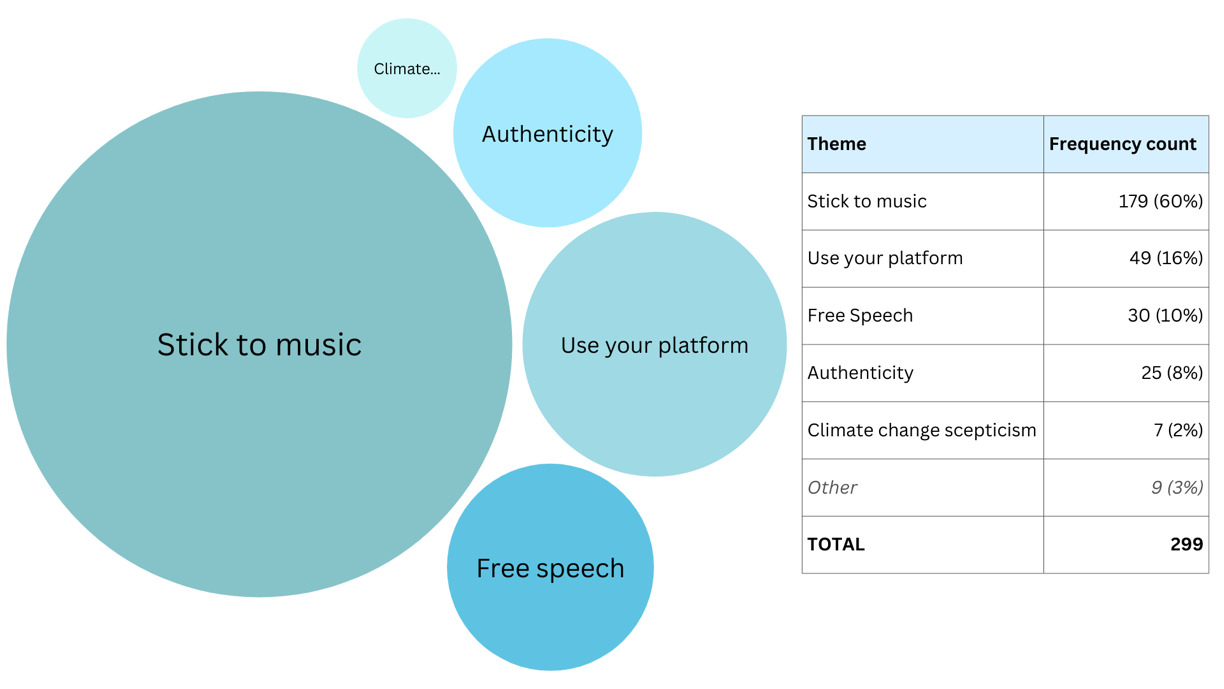
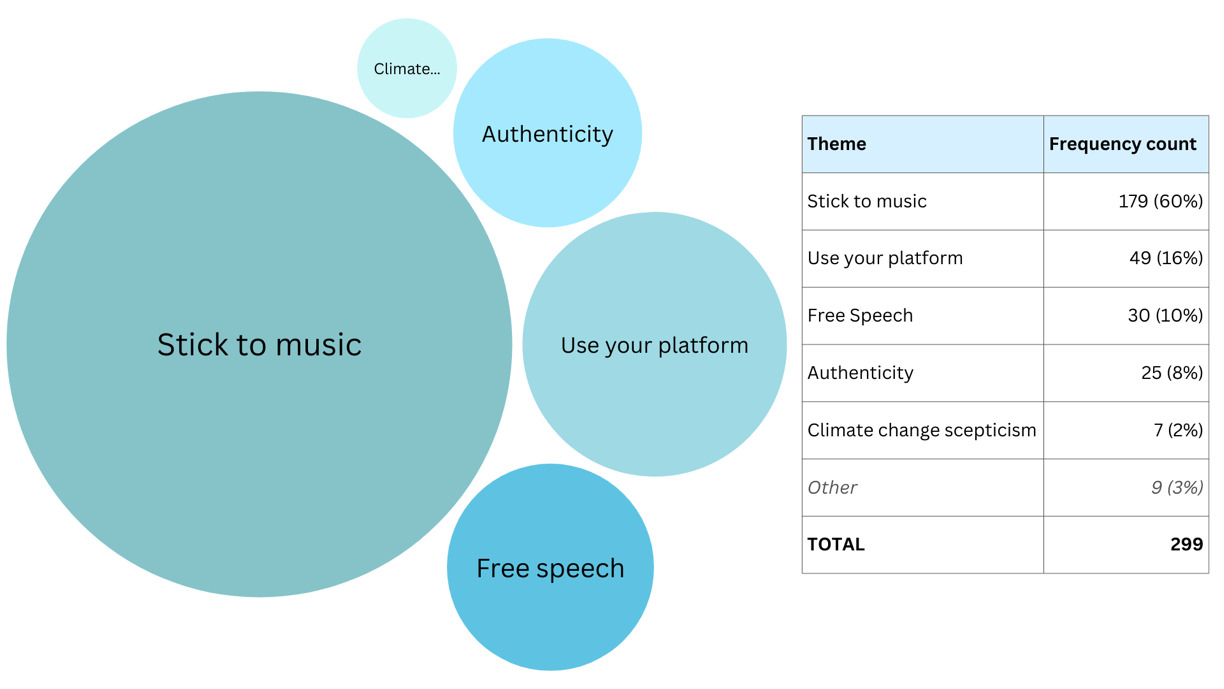
We found that approximately one third (34%) of the larger sample (N = 835) disapproved of music artists speaking in public about social issues. However, of the 299 fans who answered the optional open-ended survey item (Are there any thoughts you’d like to share about the idea of music artists speaking out about social issues and encouraging their fans to take action?) more than half (60%) framed music as purely entertainment that should remain free of activism. In analyzing responses to the target item, five broad themes emerged. We labeled these Authenticity, Climate Change Scepticism, Free Speech, Use Your Platform, and Stick To Music (Figure 1). Nine responses did not fit into any of these categories, nor did they group together around a single theme. These responses were simply labelled Other and are not described further.
Stick to Music
More than half (60%) of fans who answered the optional open-ended survey item framed music, especially live concerts, as purely entertainment that should remain free of activism. These fans suggested musicians should “just shut up and sing” or “stick to music.” This sentiment was often delivered with strong emotional valence, including expletives and declarations that fans would boycott artists who “preached” during shows.
“Play the f*cking music, no one wants 1-sided politics pushed on them.” (18- to 24-year-old fan of Guns N’ Roses)
“They should not use their fame or status to push a bullshit, woke agenda on their fans … Go f*ck yourself.” (45- to 54-year-old female fan of Chris Stapleton)
“They’d lose me as a fan. I’m there to hear music, not be preached to.” (55- to 64-year-old male fan of Tom Petty)
“They can all keep their opinions to themselves. [This is the] reason Bruce [Springsteen] is no longer my #1 concert go-to … I go to see the show, not get preached at.” (55- to 64-year-old fan of Kenny Chesney)
Some fans expressed the belief that artists should avoid social and political issues entirely.
“I never want to hear an artist’s opinion on social issues. I pay my favorite artists and bands to entertain me, not to preach at me or virtue signal.” (45- to 54-year-old male fan of NEEDTOBREATHE)
“Don’t mix entertainment with politics! I can’t trust it! I will always think there is a big check behind it!” (35- to 44-year-old female fan of Drake)
“I listen for the music, not their political beliefs.” (45- to 54-year-old male fan of Morgan Wallen)
“Just play the music and keep politics out of it.” (35- to 44-year-old female fan of Alt-J)
Others suggested activism and advocacy should be confined to personal time and platforms, preserving concerts as politics-free zones.
“I have no problem with artists sharing their options on social media or interviews, but I am strongly opposed to hearing about them at concerts. I am there to listen to music not to be lectured about any topic, it doesn’t matter if I agree with them or not.” (45- to 54-year-old female fan of Dierks Bentley)
“Not at a concert. On social media or rally or conference.” (Over 65 female fan of Pink Martini)
“Music artists have the right to speak about whatever they want, just not while they’re performing. We pay to hear them perform, not listen to them preach about political issues.” (45- to 54-year-old male fan of HARDY)
“We’re paying to escape the world we live in when we go to concerts … Use social media or other platforms to preach to the choir!” (55- to 64-year-old female fan of Robert Plant & Alison Krauss)
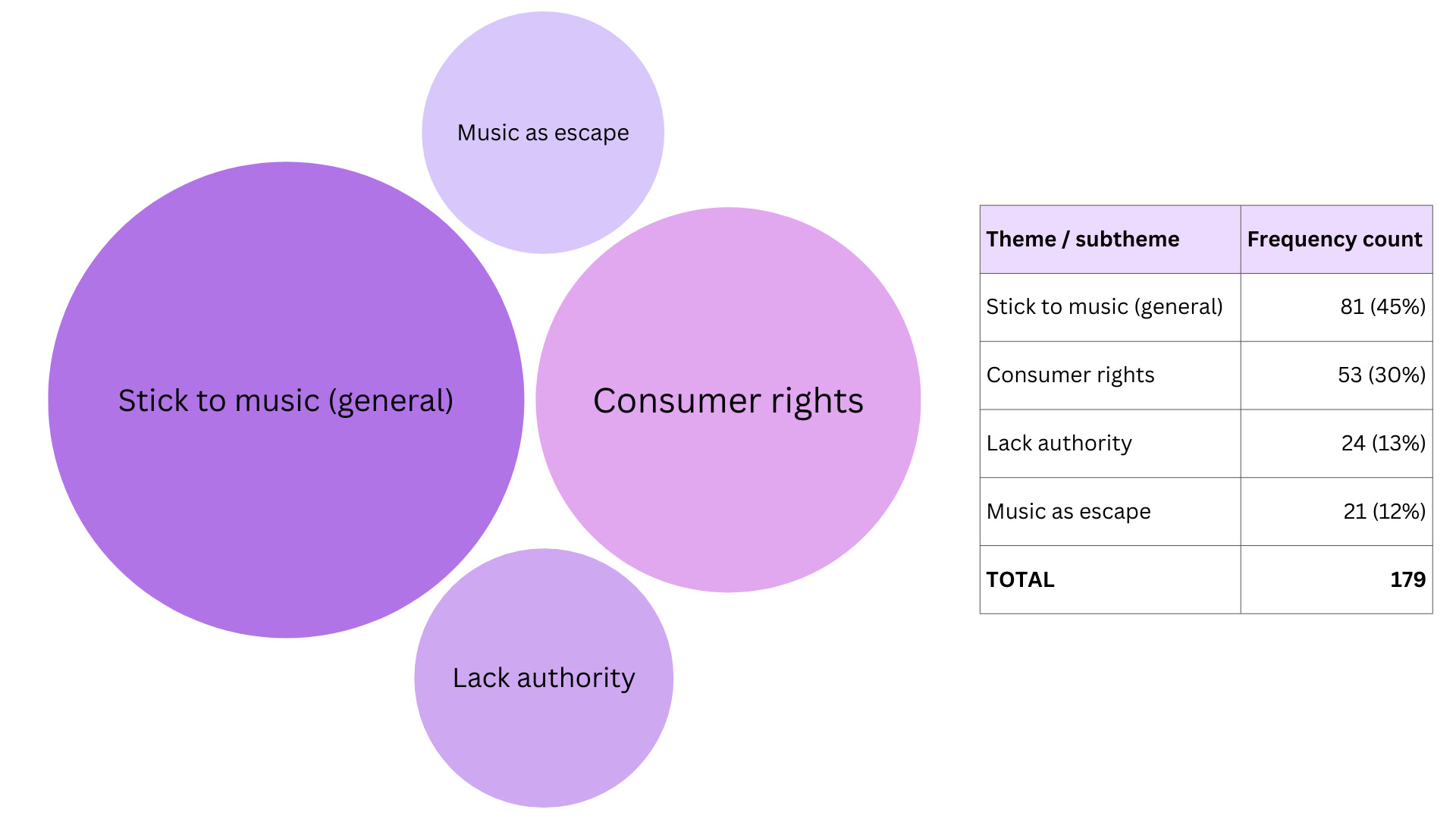
Within this category of Stick to music, three subthemes emerged (Figure 2), suggesting that fans want musicians to focus on the music for a few distinct reasons. We labelled these Consumer Rights, Concerts as Escape, and Lack of Authority.
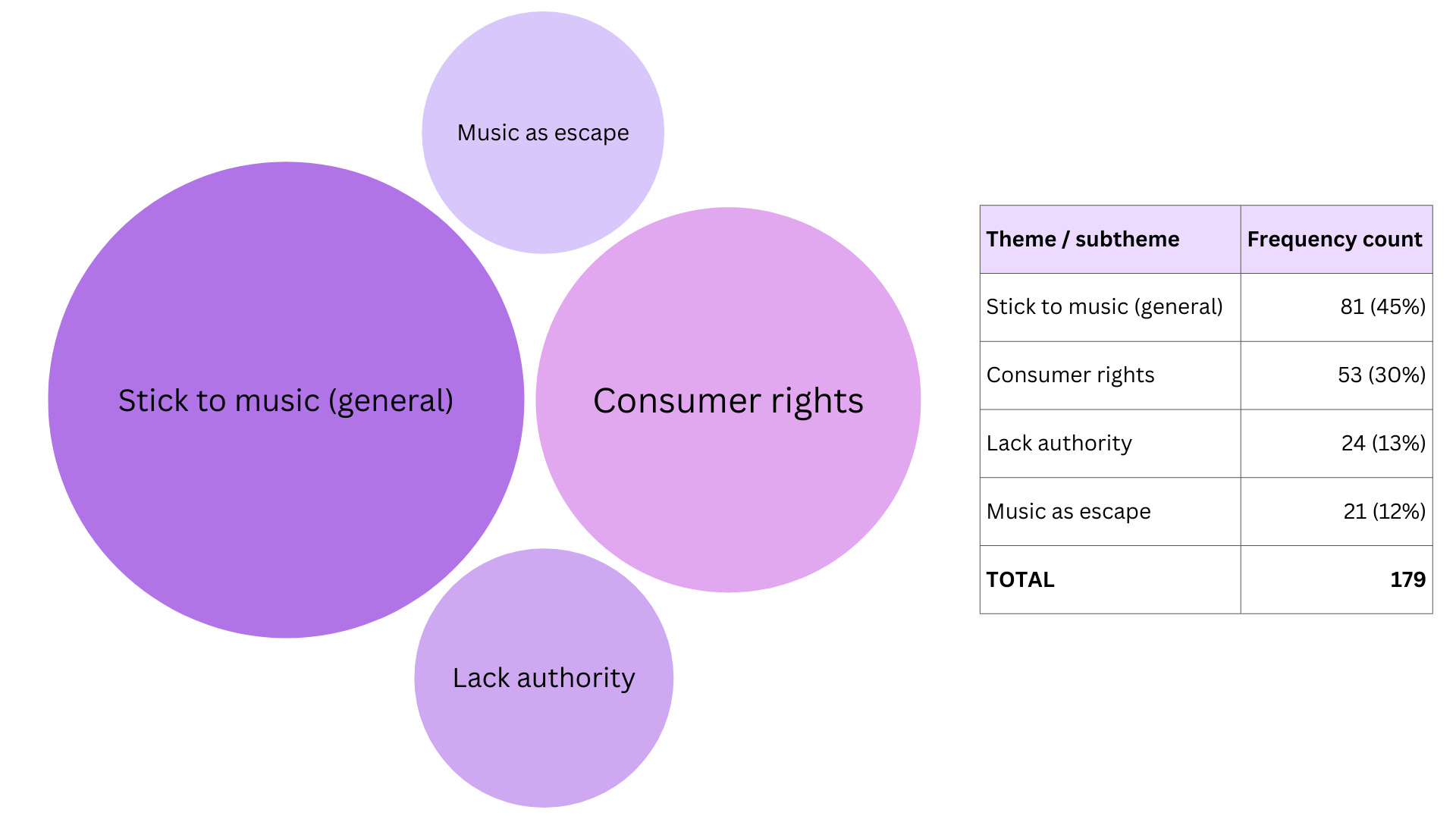
Consumer Rights. Within the broad category of Stick to music, 30% of participants expressed frustration at the idea of paying for an experience only to encounter messaging they perceived as unsolicited or propagandistic. Collectively, these responses reflect a consumer rights perspective, wherein audiences expect agency over their paid experiences and reject perceived overreach by performers.
“I don’t want my performance that I paid to attend, ruined by the artist espousing their political beliefs. Just perform and don’t abuse the stage by sharing propaganda.” (55- to 64-year-old female fan of Adele)
“Music artist should not try to preach their views to their paying fans who simply want to hear and enjoy the music. People don’t want their paid time wasted hearing an Artist trying to influence their views on fans. Not the time or place.” (25- to 34-year-old, male fan of Metallica)
“I do not spend my VERY hard-earned money to be lectured at a concert. Do not scold me, do not criticize me. Just entertain me. That is THE ONLY THING you are getting paid to do.” (Fan of Taylor Swift)
Lack of Authority. Another subset of Stick to music responses (13%) questioned the legitimacy of artists as authorities on sociopolitical issues, arguing that musical talent does not translate to expertise in complex matters like climate change or public policy. Respondents dismissed celebrity advocacy as uninformed trend-following, often characterizing artists as lacking the education or real-world experience to offer meaningful perspectives. Some responses framed artist activism as presumptuous, criticizing performers for assuming their opinions carry inherent weight simply because of their platform. Others rejected the premise that musicians could influence their personal beliefs, asserting independence in forming their own views through research rather than celebrity endorsements.
“They are artists, not scientists, not doctors, not experts.” (45- to 54-year-old female fan of Tim McGraw)
“Stick to making music. Unless they have a scientific background and are doing their own research, they are just parroting someone else’s talking points. I don’t care what they think about social issues. Shut up and play!” (45- to 54-year-old male fan of Styx)
“I think anyone and everyone needs to stay in their own lane.” (45- to 54-year-old female fan of The Offspring)
Concerts as Escape. An additional 12% of respondents who believed artists should Stick to music emphasized that concerts serve as an escape from the stresses of daily life, with many explicitly stating they attend live music events to temporarily disconnect from political and social tensions. These participants viewed artist advocacy during performances as an intrusion into what should be a carefree, aesthetic, unifying experience. A recurring argument centered on the idea that fans seek relief from—not reminders of—societal divisions, with some describing political or activist messaging as antithetical to the cathartic release they expect from live music. Others noted that contentious topics risked fracturing the communal atmosphere of concerts, where audiences ideally share enjoyment rather than debate ideologies.
“People use concerts to get a break from news, politics, work, etc. The last thing they want is bringing those items up during their time they are using to get a break.” (35- to 44-year-old male fan of Zac Brown Band)
“Music should bring us together and not further divide one and other. So just perform the music and allow us to escape reality for a short period of time.” (35- to 44-year-old fan of Shinedown)
“We go to concerts to get away from this mad twisted world.” (55- to 64-year-old male fan of Dream Theater)
Use your Platform
Other fans (16%) expressed support for artists using their platforms to advocate for sociopolitical issues, viewing it as both a responsibility and an opportunity to drive meaningful change. These respondents argued that artists, as influential public figures, can amplify critical messages—particularly for younger fans who look to them for inspiration.
“I think celebrities and artists have the platform to make change! There is a social obligation that these people use their social power to discuss issues they believe in. These issues impact every single one of us, not just those who care to speak up.” (18- to 24-year-old female fan of Noah Kahan)
“Look at Halsey, she has been a great example for years of being outspoken and I absolutely love it.” (25- to 34-year-old male fan of Taylor Swift)
“Musicians have a lot of power and if they can influence their fans to work towards a better world I’m all for it.” (Over 65 female fan of Santana)
Some highlighted music’s historical role in activism across genres as evidence that artistic expression and advocacy are inherently linked.
“Artists have used music to speak out about issues important to them for as long as there’s been music — from Gospel to Folk to Rap to Rock. Artists of all kinds use their creativity to express beliefs, and there no reason why social issues can’t continue to be expressed in a creative way.” (45- to 54-year-old fan of Andy Summers)
While most emphasized that artists should leverage their visibility to educate and mobilize audiences, a few cautioned against overly preachy delivery.
“Don’t over-emphasize it at concerts. We are here to hear you, but mostly as fans of your music. Speak your mind at concerts, but I don’t want to be preached [at] at a concert … even as an environmentalist.” (45- to 54-year-old male fan of Nothing but Thieves)
Freedom of Speech
A smaller portion of respondents (10%) defended artists’ right to free speech, acknowledging that musicians—like all individuals—should be able to express their views.
“Artists should be able to voice their concerns and actions just like the rest of us.” (45- to 54-year-old male fan of Rhett Miller)
“Go ahead 1st Amendment.” (Over 65, male fan of Joe Bonamassa)
Many emphasized that while artists are entitled to advocate for causes they believe in, audiences are equally entitled to disregard or disagree with those positions.
“Artists are always free to support whatever causes they believe in, but as agents of commerce they must also accept the consequences of potentially losing fans by doing so.” (45- to 54-year-old male fan of George Benson)
“Any artist can use their platform to support anything they want; however, that doesn’t mean I will change how I act.” (45- to 54-year-old male fan of Larkin Poe)
Authenticity
Other fans (8%) highlighted the importance of authenticity in artist advocacy, with respondents expressing scepticism toward performative activism. Several noted that credibility depends on an artist’s demonstrated commitment to the cause and alignment of their practices with their messaging. Some suggested that artists could strengthen their advocacy by directly engaging with on-the-ground initiatives at their concerts, rather than merely delivering scripted stage speeches. The underlying demand was for congruence: if artists speak out, they must “walk the talk” to avoid perceptions of insincerity or profit-driven posturing.
“If an artist is genuinely for the topic, I’m for any topic. I don’t want them speaking about something they don’t care about.” (25- to 34-year-old non-binary fan of Dave Matthews Band)
“I feel like the artist has to have history of volunteering or actually helping with the issue in order to be credible. And more people are credible for certain topics than others. I wouldn’t trust Drake speaking on LGBT rights as much as Lady Gaga.” (25- to 34-year-old female fan of Beyoncé)
“If an artist truly supports a social issue and is doing so out of genuine concern, I’m all for it. The more attention that is brought to important issues, the better off we’ll be.” (45- to 54-year-old female fan of Harry Styles)
Climate Change Scepticism
A small but vocal subset of respondents (2%) expressed scepticism towards climate change, dismissing it as a hoax, political fabrication, or exaggerated concern. These comments often included conspiratorial language (e.g., “climate scam,” “money grab”) and cited perceived hypocrisy among elites (e.g., politicians owning coastal properties) as evidence against the validity of climate science. Notably, these views were outliers in the dataset but underscored both the polarized nature of climate discourse, particularly when linked to celebrity influence, and the vehemence of these minority voices who, with social media, have found a large megaphone. While not representative of broader sentiment, such perspectives highlight a segment of audiences that may actively disengage from—or antagonize—artists who promote climate action (or perhaps support those who espouse similar views).
“Climate change is fake news.” (45- to 54-year-old fan of Lionel Richie)
“The climate isn’t changing. Check the data.” (55- to 64-year-old male fan of Dead & Company)
DISCUSSION
This qualitative study offers new insights into how fans respond to sociopolitical advocacy by popular musicians. The substantial proportion of respondents who oppose advocacy—particularly during live performances—underscores the cultural tension surrounding celebrity engagement in social issues. Thematic analysis of qualitative responses suggests that many fans view concerts as apolitical entertainment spaces, resistant to what they perceive as unsolicited ideological messaging. These reactions echo broader public sentiments observed in contexts such as athlete or actor activism, where audience expectations of “staying in one’s lane” conflict with performers’ use of platforms for public engagement. They also reflect what Frith (1978, 1988) would characterize as genre-as-identity violations. When an artist steps outside the role their genre implicitly assigns them, fans may experience the transgression as a breach of social contract rather than simply an unwelcome opinion. Hailey et al. (2025) find that genre context can actually intensify resistance. A political message delivered by a beloved artist from the “wrong” political camp may provoke stronger rejection than the same message from a stranger.
It is important to note that when we looked at results from the larger survey (N = 835), only 34% of the overall sample disagreed with music artists speaking in public about social issues. Yet among those who elaborated in open-ended responses (n = 299), 60% emphasized that artists should “stick to music.” This suggests that opposition may be disproportionately vocal, raising important questions about how backlash is amplified in both public discourse and digital arenas. It also highlights the affective intensity of resistance, particularly when activism is seen as intrusive, inauthentic, uninformed, or misaligned with fan expectations. This pattern is consistent with Grossberg’s (1984, 1992) notion of affective alliances, wherein fans who have staked their sense of self on an artist’s persona may respond to perceived betrayal with disproportionate intensity. Platform architecture further amplifies this dynamic, as algorithms structurally favor outrage over measured agreement (Bail et al., 2018), potentially distorting the public perception of how widespread opposition actually is.
Our results also reveal important distinctions between advocacy platforms. Social media may offer a lower-stakes space for artists to engage in activism, with some fans expressing greater comfort with digital expressions of advocacy. In contrast, live events elicit more polarized responses, perhaps due to the immediacy and emotional immersion of concerts. The greater polarization observed in live settings is consistent with both Durkheim’s (1912/1995) concept of collective effervescence and Edelman’s (1964) framing of public gatherings as political rituals — contexts in which messages carry symbolic weight that extends beyond their literal content, heightening both receptivity and resistance. The emotional immersion of concerts may intensify responses in both directions, consistent with Saarikallio et al.'s (2013) Affective Response Model, which holds that live musical contexts generate stronger and more socially reinforced emotional responses than passive listening.
The data further suggest that authenticity and perceived expertise play crucial roles in shaping receptivity. Fans are more likely to accept activist messaging when they perceive it as aligned with the artist’s values and career history, rather than as opportunistic or performative. The centrality of authenticity in fan receptivity aligns with Social Identity Theory’s prediction that in-group representatives are held to higher standards of value consistency (Jetten et al., 2001; Tajfel & Turner, 1979). An artist perceived as opportunistic is not merely unconvincing but may be experienced as a kind of identity fraud.
There are several limitations to this study that should be considered in interpreting our findings and addressed in future research. Our results rely on responses to a single survey item. More comprehensive responses and possible explanatory mechanisms could be obtained from deeper questioning. Our sample was limited to fans who had recently purchased concert tickets using Ticketmaster and may not represent the general population. Public scrutiny of Ticketmaster/Live Nation may have shaped attitudes and influenced which invitees chose to respond. Voluntary response samples are always at least somewhat biased, as some people will inherently be more likely to volunteer than others, leading to self-selection bias.
CONCLUSION
These findings offer a nuanced view of the opportunities and risks associated with musician-led advocacy. For scholars, this study contributes to emerging work on the sociopsychological dynamics of fan-celebrity relationships and participatory fandom. Future research should examine the longitudinal effects of celebrity advocacy on behavioral outcomes, and further explore individual differences in fan responses, including cross-cultural variations. For practitioners—including musicians, managers, and climate communicators—these findings suggest that while advocacy can be a powerful tool for engagement, it must be wielded with strategic sensitivity to avoid alienating segments of the audience. Artists seeking to engage their audiences on sociopolitical issues should consider not only what they say, but how, when, and where they say it, echoing Lasswell’s (1948) communication framework of who says what, in which channel, to whom, with what effect? Tailoring messages to audience values, leveraging platforms suited to the content, and maintaining perceived authenticity may help to maximize impact and minimize backlash. And don’t let the haters grind you down; they can be loud but may only represent the minority view.
Acknowledgements Statement
We wish to thank Caleb Johnson at Planet Reimagined for sharing the dataset and advising on survey design and data collection methods. We’d also like to thank several members of our lab: Grace Fleming for her contributions as the second coder, and Madison Richardson and Maya Sutton-Hall for carefully reading and providing feedback on earlier drafts of this manuscript.
Conflict of Interest Statement
The authors have no conflicts of interest to declare.
Funding Statement
This project was funded in part by the Natural Sciences and Engineering Research Council of Canada (grant #: RGPIN/04572-2023 awarded to DL).
Ethics Statement
This study used an anonymized dataset provided by Planet Reimagined. As no new human subjects were recruited and no identifiable information was accessed, the research did not require institutional ethics review. All original data collection procedures complied with applicable ethical guidelines for survey research.
Data Availability
Raw data available from Planet Reimagined, caleb@planetreimagined.com.